


How does clutter affect your emotional wellbeing?

The connection between our home and our mental state is constant. Every cluttered drawer, every overflowing closet, every room that doesn't quite work — your nervous system feels all of it, all day long.
I have worked with many clients in spaces that looked fine from the outside but felt completely overwhelming from the inside. And in almost every case, the chaos in the room was mirroring something happening in the mind. The two are inseparable.
After working through kitchens, bathrooms, storage rooms, closets and toy areas, I have noticed the same pain points coming up again and again.
Here's what I have seen, and why it matters more than you might think.

1. Clutter isn't just visual, it's an emotional weight:
We tend to talk about clutter as an aesthetic problem. But the clients I work with feel it very differently. They feel it as exhaustion, as shame, as that constant background feeling that something isn't right.
Decluttering can bring up different emotions and memories:
Paperwork from a late parent that's painful to sort through
Baby clothes that feel impossible to donate, marking the close of a chapter
Half-finished hobby projects that make us question who we still are — and who we used to be
Kids' drawings that are hard to throw away
These aren't just things. They're feelings that have been given physical form and stored in a room.
While working through a client's home, her partner told me the state of their home had been putting a real strain on their relationship. After our first session, she broke down crying — not because the process was hard, but because letting go is. And because seeing everything laid out made her realise, for the first time, just how much had accumulated and how much work was ahead.
When clutter starts affecting your relationship, it's no longer just a home problem. It's a life problem, and it deserves to be taken seriously.

2. The spaces we live in shape how we function:
Think about your home...
➡️ When you walk into your bedroom and there's clutter on every surface, can you actually rest there? Or do you feel frustrated, aware of everything that needs to be organized?
➡️ When you cook and you have to move three things to find the one you need, does that small frustration set the tone for the whole meal?
➡️ When your children's play area has no defined zones, with toys all over the place, can they actually enjoy playtime?
➡️ If everything is mixed together in your closet with no clear order, getting dressed in the morning isn't an easy task. It's a small battle... before your day has even started.
Furniture placement also matters more than most people expect. While working with a client who has ADHD, I recommended shifting the layout of her closets, as they were taking up most of the light and space in her small studio. She was hesitant at first — but then looked at me and said "let's do it." She even added: "I need a better closet." So we got a new one, let go of what wasn't working, and reorganised the whole space.
The result? More natural light, more space — but most importantly, a room that finally felt calm. Somewhere she actually wanted to get dressed in the morning. That one change made a huge difference in her studio, and in her mind.

Before

After
These aren't coincidences. The way a space is arranged directly affects how we move through it, how we feel in it, and how much mental energy we spend just navigating it.
3. Without a system, the chaos comes back:
This is the part most people skip — and it's the most important one.
You can have a beautifully organised kitchen for a week, and two months later the drawers are full of unrelated items again and the top of the cabinet has become a drop zone for children's drawings and unopened documents.
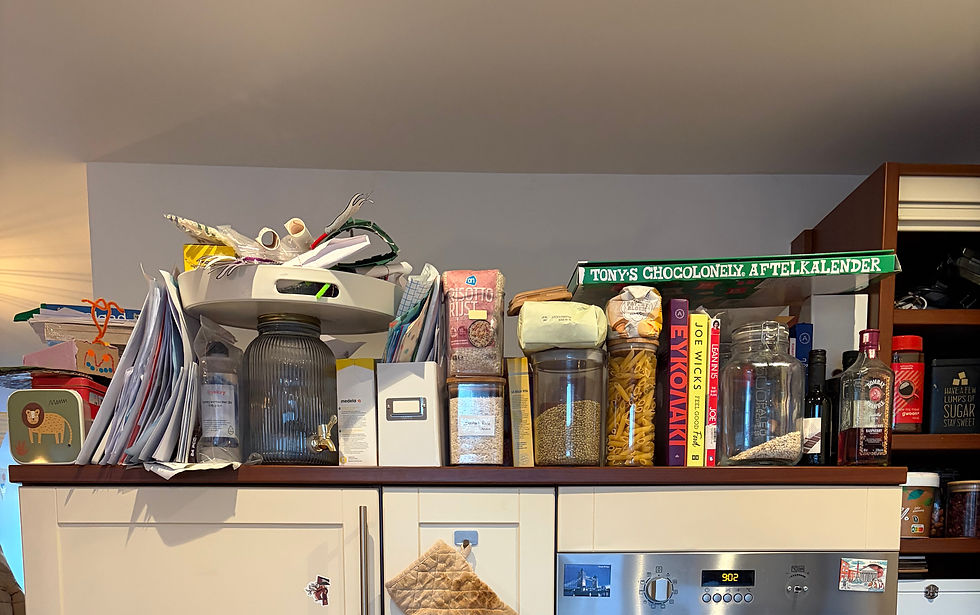
It's not a lack of effort. It's a lack of structure. When things don't have a clearly defined home, they end up wherever there's space nearby.
4. Most frequent pain points:
These are the pain points I see most often when working with clients:
When life gets hard, the home is often the first thing to slip — clutter builds not because we're lazy, but because we're human.
Clutter creates real tension between people who live together, and arguments that seem to be about the dishes rarely ever are.
When someone has tried to get organised before and failed, they don't just have a practical problem — they carry shame about it.
Anxiety and ADHD make it genuinely harder to create and maintain systems, and a space that works for a neurotypical person may feel completely unmanageable to someone whose brain works differently.
Living in a chaotic space keeps your nervous system in a low level of stress all the time — you may not notice it anymore, but your body does.
When clutter carries emotional weight — inherited items, a child's keepsakes, things tied to a past version of you — letting go becomes grief.
The embarrassment and shame of inviting friends and family into our homes because the house is really cluttered.
Where do you start?
You don't need to declutter everything at once.
✔️ Start with the spaces that affect you most — wherever you begin and end your day. Your bedroom. Your kitchen. The area just inside your front door.
✔️ Ask yourself: does this space support who I am now? Does it make my daily life easier or harder? Does being in this room make me feel calm or tense?
Your home is already affecting how you feel.
Ready for your own transformation?
I work with clients in-person across the Netherlands and virtually from wherever you are.
If you're not sure where to start, my free Home Declutter Sample is a gentle first step — a practical guide to help you begin decluttering room by room, at your own pace.
If you're ready to go further, explore my services here or send me a DM on Instagram @theorganizationplan — I'd love to hear about your space.


Comments